07.10.2026
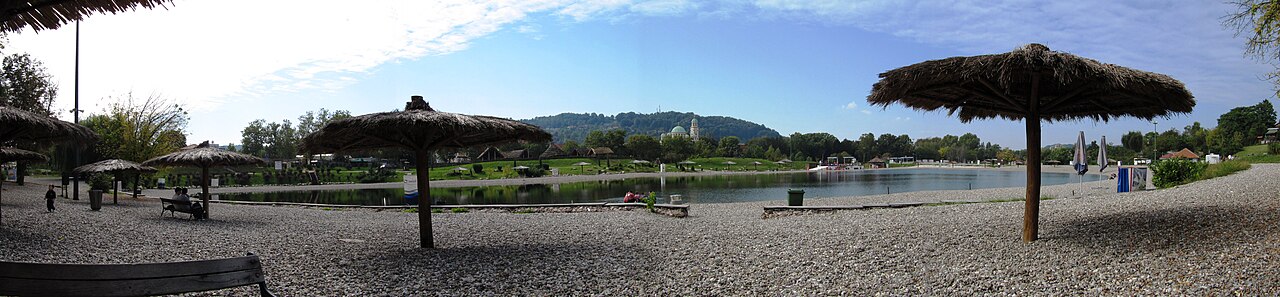
The northeast of Bosnia does not look like Mostar and does not look like the Una. Here are the plain, salt and fortresses on lonely rocks. Tuzla holds salt lakes in the middle of the city. Srebrenik holds a tower on the cap of a cliff. Gradačac holds a rampart and a clock. Konjuh is the forest south of Tuzla. Tešanj is an old bazaar with a clock tower, closer to central Bosnia than to the Pannonian plain, but it belongs to this arc of the road. The guide does not turn this district into a coast. Its beauty is another kind.
Summer is the season of the lakes. The water is salt, the city is on the shore, and the shade comes from avenues, not from a mountain. Autumn opens Konjuh. In winter the fortresses remain and the swimming does not. Firms in Tuzla sit on the city map.

The Pannonian lakes are in the centre of Tuzla, filled with salt water from the salt mine. They are not a natural lake in a forest. This is a city park that in summer becomes a place to swim, with a promenade, small bridges and a view of the buildings. The rarity is that you swim in the middle of the city, in water that is not a river. Come by day if you want both the walk and the water. Toward evening the shore remains a walk even when the pool grows quiet.
Tuzla does not reduce to the lakes. The square, the older streets and the hills on the horizon give another hour. If you stay only on the sand, you have seen the season, not the city. Look for the firms by the shore and in the centre in the directory, with an address.
Srebrenik is a fortress on a high rock, north of Tuzla. The path to the gate climbs, and the walls stand as if they had grown out of the stone. It is not large. An hour is enough to walk the ramparts and see the plain below. The wind on the rock is stronger than on the lake shore. Do not climb outside the wall. The view is the reason to come, not a photograph from a dangerous edge.
Tuzla and Srebrenik fit in one day. Gradačac asks for another hour of driving and its own afternoon if you want the rampart, not only a pass.
Gradačac holds the fortress and the clock tower tied to Husein-kapetan Gradaščević. The tower is seen from the town, and the rampart asks for a climb. The old part is not large. A walk from the square to the tower and back covers the end of a day. In summer the stone is hot. Autumn is quieter. The town lies in the Posavina, closer to the plain than to a mountain, and so the walk differs from the cobbles of Mostar.
Konjuh is a forested mountain south of Tuzla. It has no salt lake and no clock tower. It has beech, streams and paths that lead toward the heights and the lakes in the forest. The visit makes sense if you have had enough of the city and want shade. The paths are not a quay. Shoes and the forecast matter more than a list of viewpoints. One shorter entry into the forest covers a morning. The whole massif does not fit beside Srebrenik on the same day.
Do not light a fire where it has no place and do not leave a trace the forest cannot take. Konjuh is the reason the northeast is not only a plain.
Tešanj is an old town with a fortress, a clock tower and a bazaar that climbs. It is closer to the valley toward Zenica than to Tuzla, but on the road of the northeast it stands as the last stone before central Bosnia. The cobbles are narrower than in Tuzla. An hour of walking covers the tower, the rampart and the bazaar if you do not hurry. Crafts and coffeehouses keep the street alive. Choose a firm from the directory, not the first shop window.
The northeast is remembered for salt water in the middle of a city and for towers that stand alone on rock. It is not the postcard of the south, and it does not have to be. The firms stay in the directory, and this text does not invent their hours.